There are concept albums that rely on elaborate narratives, and then there are those rare projects that allow an idea to quietly permeate every note. On Four Lemmas, Nigerian-born, New York–based artist UDEiGWE achieves the latter, crafting an elegant contemporary jazz suite that transforms abstract concepts into deeply human experiences. Inspired by the mathematical notion of a lemma—a supporting proposition that helps build toward a larger truth—the album unfolds across eight interconnected movements, pairing four “lemmas” with four corresponding “corollaries.” Yet despite its intellectual foundation, Four Lemmas never feels academic. Instead, it is warm, reflective, and surprisingly intimate.
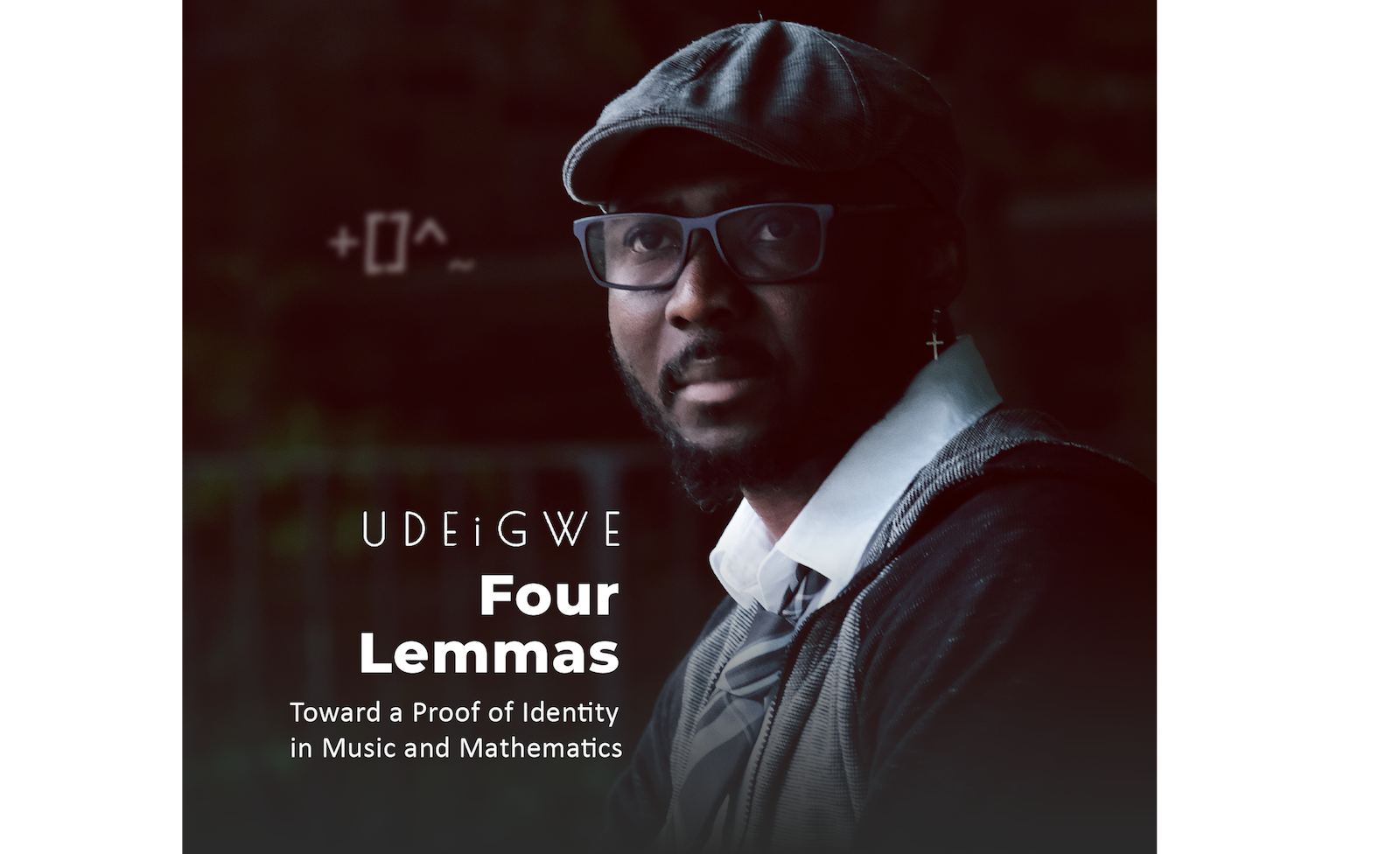
From the opening “Prologue: Four Lemmas,” UDEiGWE establishes an atmosphere of contemplation. Piano, trumpet, bass, and drums move with remarkable restraint, allowing silence and space to become active participants in the music. The result is a listening experience that rewards attention without demanding it, drawing listeners into its world through mood rather than complexity. Each section explores a distinct emotional and philosophical terrain. “Lemma I: Orthogonality” reflects on independence and individuality, while “Sparse Matrix” examines reduction and clarity without sacrificing meaning. “Local Maximum” offers one of the album’s most compelling ideas, challenging the notion that achievement represents finality. The closing “Stable Equilibrium” serves as a fitting conclusion, not as a resolution, but as a meditation on balance sustained through continual motion. What makes Four Lemmas particularly compelling is the way UDEiGWE integrates spoken-word passages throughout the album. Rather than interrupting the musical flow, these narrated lemmas and corollaries function like guideposts, subtly shaping the listener’s understanding while preserving the project’s emotional openness. The spoken elements never explain the music outright; they simply expand its possibilities. the performances are exceptional. UDEiGWE’s vocals and piano work anchor the project with warmth and clarity, while the contributions from trumpeters Steph Clement and Wayne Tucker bring color and depth to the arrangements. Bassist Rade Bema and drummer Josh Green provide a rhythmic foundation that remains fluid and responsive throughout, creating the sense of a living conversation rather than a series of fixed compositions.
The album’s production, mixed and mastered by Dave Darlington, further enhances its cinematic quality. Every instrument occupies its own space, allowing the ensemble’s subtle interactions to emerge naturally. Nothing feels overcrowded, and every musical gesture carries weight. What ultimately distinguishes Four Lemmas from many contemporary jazz releases is its refusal to separate intellect from feeling. UDEiGWE, who is also a Professor of Mathematics at Manhattan University and a research affiliate in cognitive and brain sciences at MIT, brings his scholarly background into the project without allowing it to overshadow the music. The mathematics remain beneath the surface, informing the architecture while emotion drives the experience. The album succeeds because it understands a simple truth: listeners do not need to understand a structure to feel its effects. Much like a well-crafted proof reveals elegance through logic, Four Lemmas reveals beauty through balance, patience, and intention. At a time when many records compete for attention through volume and immediacy, Four Lemmas chooses a quieter path. It asks listeners to engage, reflect, and discover meaning gradually. The reward is a work of unusual depth—one that lingers long after its final notes have faded.
Listen & Follow
► Listen to Four Lemmas
► Visit Official Website
► Follow on Spotify
► Follow on Instagram
► Subscribe on YouTube
► Follow on X
► Connect on Facebook