Some pieces of music don’t feel like songs so much as environments—spaces you enter rather than simply listen to. RIFF, the latest collaboration between Dutch harpist Anne Vanschothorst and producer/sound designer Thijs de Melker, sits firmly in that territory. Inspired by Bob Gramsma’s land art monument Riff, PD#18245, the release transforms acoustic harp into an evolving ambient world shaped by landscape, memory, and perception.
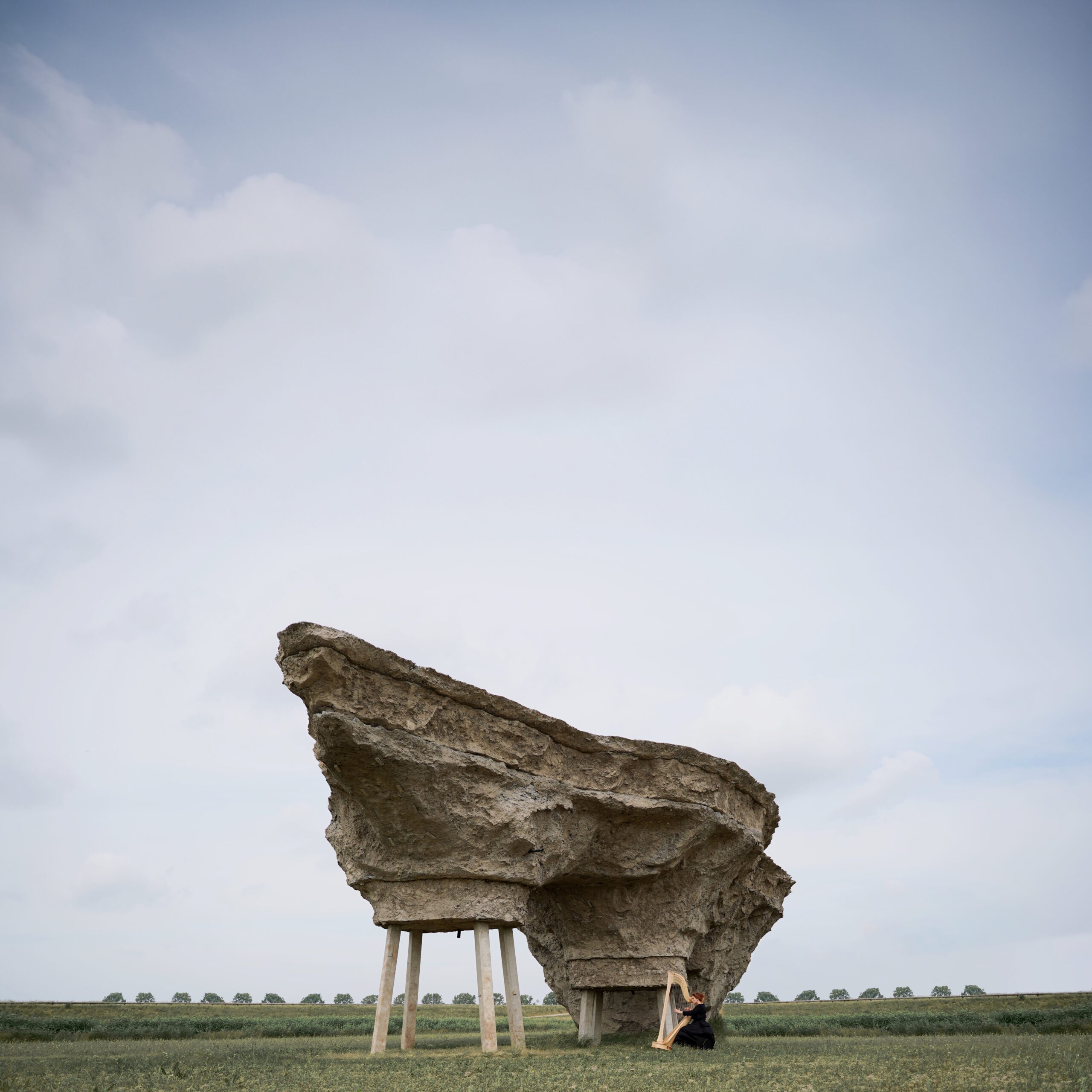
At its core, RIFF begins as something deceptively simple: an acoustic harp recording. But in Vanschothorst’s hands—and through de Melker’s careful electronic treatment—it gradually dissolves into something far more fluid. Notes stretch, blur, and reassemble into drifting harmonies that feel less composed than discovered, as if the sound itself is responding to the environment it inhabits. What makes the piece particularly compelling is its direct dialogue with place. Gramsma’s land art work, situated in the Flevoland polder reclaimed from the sea, already exists as a meditation on absence and presence—an excavation preserved in physical form. RIFF extends that idea into sound, imagining an underwater sonic landscape where memory and geography merge into one continuous, shifting field. Rather than imposing structure onto the material, the production allows it to wander. The harp is never fully “fixed” in space; instead, it drifts through layers of subtle processing and ambient textures, occasionally emerging with clarity before receding again into atmospheric haze. The result is a piece that feels alive to its own instability. This approach aligns closely with Vanschothorst’s broader artistic practice. Her work often resists traditional boundaries between music, sound art, poetry, and visual imagination, treating each as part of a shared creative ecosystem. In RIFF, that philosophy becomes especially tangible. The harp is not simply an instrument here—it feels sculptural, almost geological, as if carved out of silence and then allowed to erode naturally over time.
There’s also a strong sense of patience embedded in the composition. Nothing rushes. Nothing demands attention. Instead, the listener is invited into a slower mode of perception, one that rewards stillness and openness. It’s music that asks to be experienced rather than analyzed, unfolding in its own time regardless of expectation. De Melker’s production plays a crucial role in shaping that experience. The electronic elements never overwhelm the acoustic source; instead, they act as extensions of it, gently reframing the harp’s natural resonance into something more spatial and immersive. The boundary between acoustic and electronic becomes intentionally indistinct. The conceptual foundation of RIFF—its connection to land art, excavation, and imagined underwater space—gives the piece an added conceptual depth, but it never feels like theory overriding sound. Instead, the idea and the music seem to evolve together, each informing the other without either becoming dominant. In a broader sense, RIFF reflects Vanschothorst’s ongoing artistic philosophy: that sound is not fixed but continuously unfolding, shaped by context, perception, and imagination. It’s a perspective that turns listening into an active, almost meditative process. Quietly immersive and conceptually rich, RIFF stands as a reminder that experimental music doesn’t need to be abstract to be affecting. Sometimes its power lies in how gently it shifts the way you hear silence itself.
Connect with Anne Vanschothorst