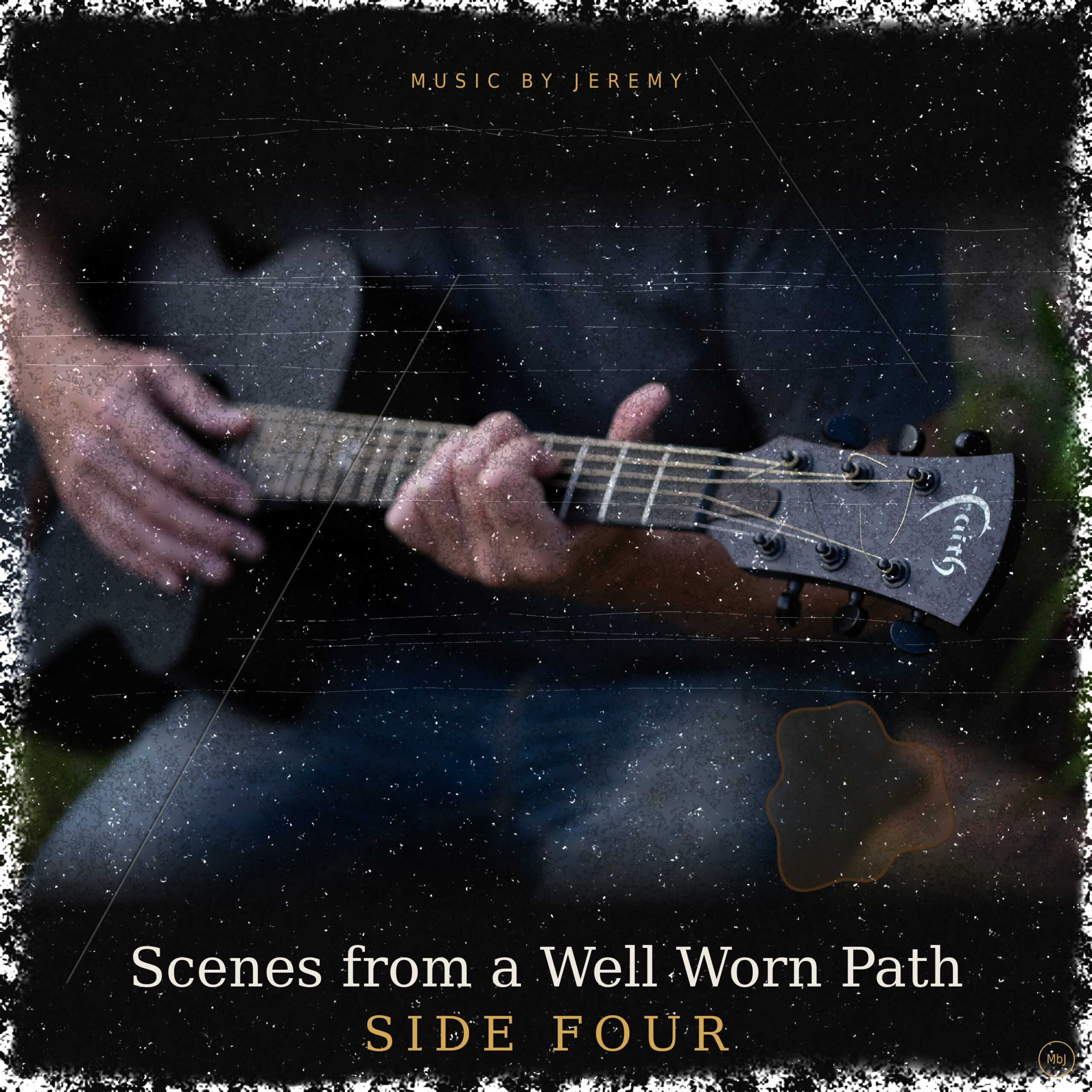
“The most meaningful songs don’t tell you what to think. They give you a reason to look at the world again, to question what you believe and to discover something you didn’t even know you’d missed.”
With Scenes from a Well Worn Path (Side Three) Jeremy takes a significant step beyond the personal in his songwriting and turns his attention to the paradoxes, the expectations and the sheer quiet absurdity of the world at large. Released 25th October 2026 this six track addition forms the third part of an ambitious 24 track, four part double album which he has conceived as a musical autobiography. This is not simply another collection of memories though. The first two sides of the album have been inward looking, Side Three opens the door to wider questions of contentment, of progress (economic and otherwise), of love and of the way we go about trying to make sense of our lives in a world that is so often confusing. The result is a songwriting project that is very much about observation rather than instruction, about curiosity rather than easy answers. Rather than delivering a political manifesto or a philosophical pronouncement Jeremy puts the ideas into a musical scene and leaves the listener to draw their own conclusions. That is the nature of the project from the very first track “No Price on Earth” which sets the tone with its title. There is no price on earth for some of the most valuable things in life. The perspective is one of calm, unadventurous contentment rather than one of achievement of some grand scale. There is no need for a triumph of any kind to make the moment in question significant. The very fact that it doesn’t offer a conclusion is part of its appeal and this is the nature of the album as a whole. Jeremy’s own description of his songwriting philosophy is a very apt one indeed: “I’m very aware of my own frailties and contradictions. That’s why I’m writing songs and not standing for parliament.” It’s a memorable quote because it is so very much the spirit of the record. These are not songs that are attempting to position the writer above the people and the problems he observes. They are songs that are aware of the frailties and contradictions of the human condition and are comfortable with the idea of uncertainty. All the music is recorded in his home studio in Banbury, England and the process is to write the song down in the form of words, acoustic guitar and voice before the arrangement is developed with the aid of AI assisted production. The technology is used to serve the songwriting rather than to supplant the human element of the song in the form of the initial ideas, the lyrics, the guitar parts, the bass and the creative decisions. That is the context of the project but the focus is very much on the material. Over the six songs Jeremy has created a space in which literary references, philosophical enquiry and the everyday experience of being human can co-exist without the album becoming a lecture. His influences are clearly there in the traditions of John Lennon, Bob Dylan, Randy Newman and David Bowie but the influence of the people and the situations he has lived through is just as strong in shaping this side of the album. It is that combination of intellectual ambition and personal observation that makes the release such a compelling songwriting statement.
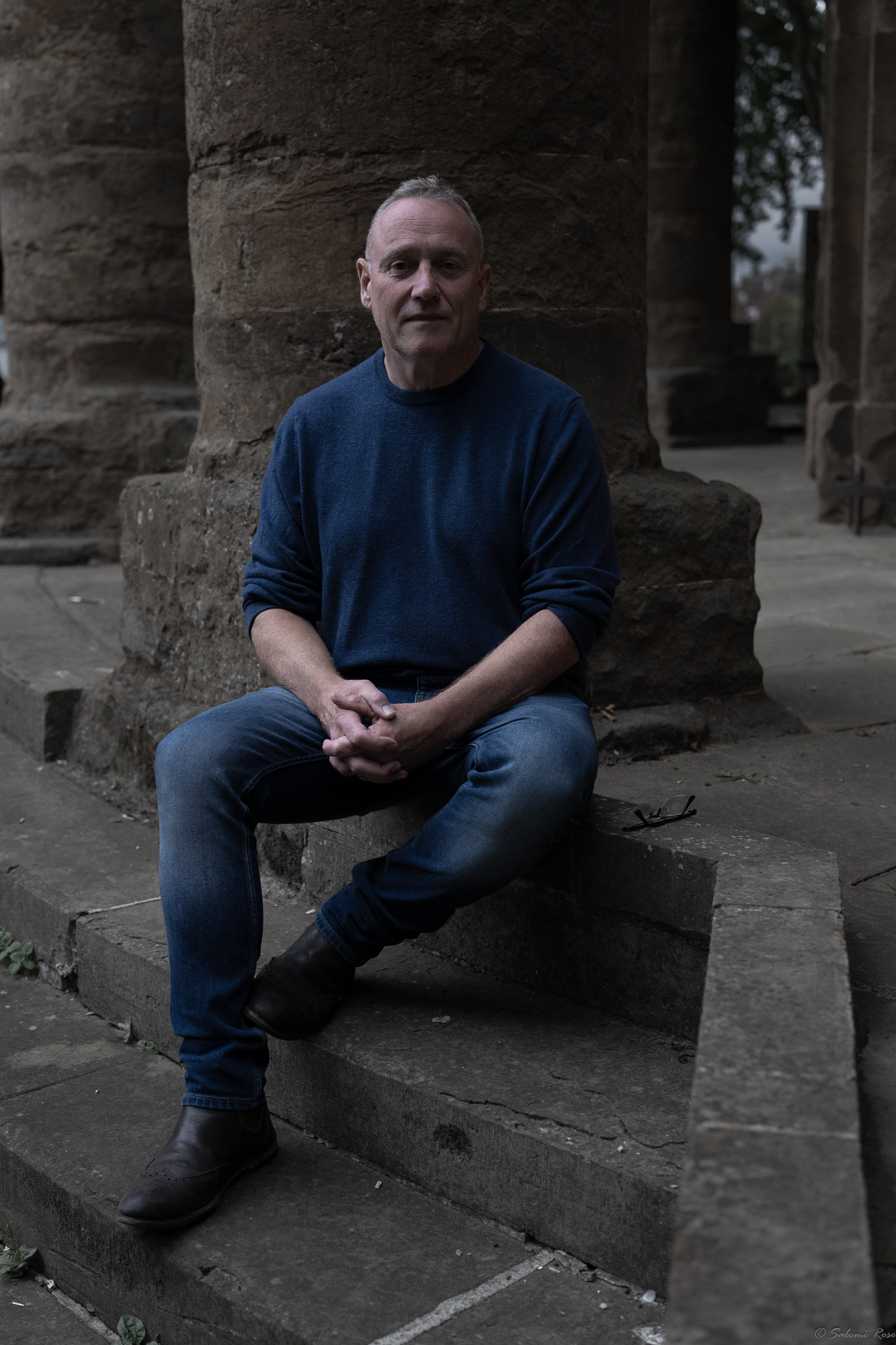
The album’s real achievement is in the way the individual songs grapple with big ideas without losing their human dimension. “Economic Possibilities for our Grandchildren” is the most obvious example, the title taken from Keynes’ 1930 essay on the economic possibilities for future generations. Jeremy uses that as a springboard to consider the gap between the promise of abundance and the actual distribution of those benefits. It opens with the line “fair is foul and foul is fair” from Macbeth, immediately setting up the idea that a warped view of the world can become the norm. These aren’t just intellectual garnish. They form the basis of a song about expectation, power and the fundamental disjunction between what we could achieve and what we in fact do achieve. Crucially, Jeremy doesn’t come at it as a sermon. He doesn’t give you a conclusion. You’re left to work out the implications for yourself. That is absolutely central to the albums’ character. The big issues become songs to live with rather than arguments to be won. “I Don’t Know” is the perfect counterpoint, shifting the focus from the grand to the intimate. It’s a deliberately bad mathematical proof in which the narrator attempts to explain his wife to Fermat, prime numbers and irrational numbers and eventually realises that the relationship can’t be expressed in any formula. It’s a very unusual take on a very familiar subject. Rather than simply stating that love can’t be explained, the song makes the failure of logic to explain it more poignant by first attempting to do so. There’s a certain humour in the premise but also a tenderness in the realisation that the inability to explain love is in fact part of what makes it real. “How Much is Enough” continues the album’s broader preoccupation with value and contentment, a question that neatly dovetails with the opening track’s suggestion that the most important things can’t always be bought. “Market Square” brings us back to a very recognisable English scene, observing a fairly ordinary working day without any of the usual drama. Its inclusion in the album reinforces Jeremy’s interest in finding meaning through observation and the idea that the everyday can be a subject worthy of examination in its own right. “The Letter” takes another familiar experience and gives it a philosophical slant through reference to Schrödinger’s cat and the problem of the falling tree. The uncertainty of the contents of an unopened letter becomes a vehicle for exploring the nature of the unknown until it is faced. The references add further layers for the listener to discover over time, but it’s not essential to understand all of them in order to appreciate the emotional and thematic core of the song. Each track is of a fairly compact nature, generally running between 3 and 3.5 minutes, allowing the ideas to develop without it becoming a very long song. The songs are rewarding in that their detail leads to wider questions, yet the situations they describe are fundamentally human.
What sets *Scenes from a Well Worn Path (Side Three)* apart is the consistency of its vision. Throughout “No Price on Earth”, “I Don’t Know”, “Economic Possibilities for our Grandchildren”, “How Much is Enough”, “Market Square” and “The Letter” Jeremy is concerned with the relationship between what people believe, what they can prove and what they actually experience. The subjects range from economics to affection to the everyday to the uncertain, but the songwriting is held together by a consistent willingness to allow for contradiction. It’s an album which understands how easily a song can become overladen if the writer is trying too hard to explain what the song is about. Jeremy’s approach is to establish a situation, develop an idea and leave the listener to make the final connection. That approach is also reflected in the recording process. Each song starts with an acoustic guitar and a vocal and the arrangement is then developed through Ableton, AI assisted drums and vocal stems, performed guitar and bass parts and additional MIDI where required. Jeremy uses the generated arrangements as a way of working out the pacing, the structure and the musical possibilities before he goes on to refine the final recording. It’s an unusual process but one that is entirely practical for a solo songwriter looking to explore the possibilities of a more fully realised production without losing the original composition as the basis. Importantly the technology doesn’t define the album. The defining characteristic is the writing, particularly the way that intellectual references are linked to the everyday rather than presented as a display of knowledge. The acoustic origins are very much present and the lyrics are at the heart of the thing, enabling the songs to work in both a more sparse, lyric-led mode and in a more fully arranged musical context. As the third chapter in a larger autobiographical project the album also occupies a significant place in the overall arc of the work. It moves beyond the world of memory into the structures, assumptions and relationships which form the world outside of the self and does so without any pretension to being outside of them. There is a quiet confidence in that. Jeremy doesn’t need every song to have a final answer because the act of asking the question can be a very valuable thing in itself. “Big ideas are most powerful when they are lived through the ordinary rather than delivered as instructions” is the guiding principle of the album, whether it’s the pursuit of contentment, the mathematics of love or the meaning of an unopened letter. *Scenes from a Well Worn Path (Side Three)* is therefore more than a collection of songs which have literary and philosophical references in them. It is an invitation to pay more attention to the world around you to question the assumptions you have, to be aware of the limits of certainty and to find significance in the things that you might otherwise just go on to ignore. Music by Jeremy has produced a thoughtful, independent piece of work which trusts the listener to meet it halfway, offering sufficient substance to reward repeated listening while keeping its central concerns firmly rooted in the business of being human.