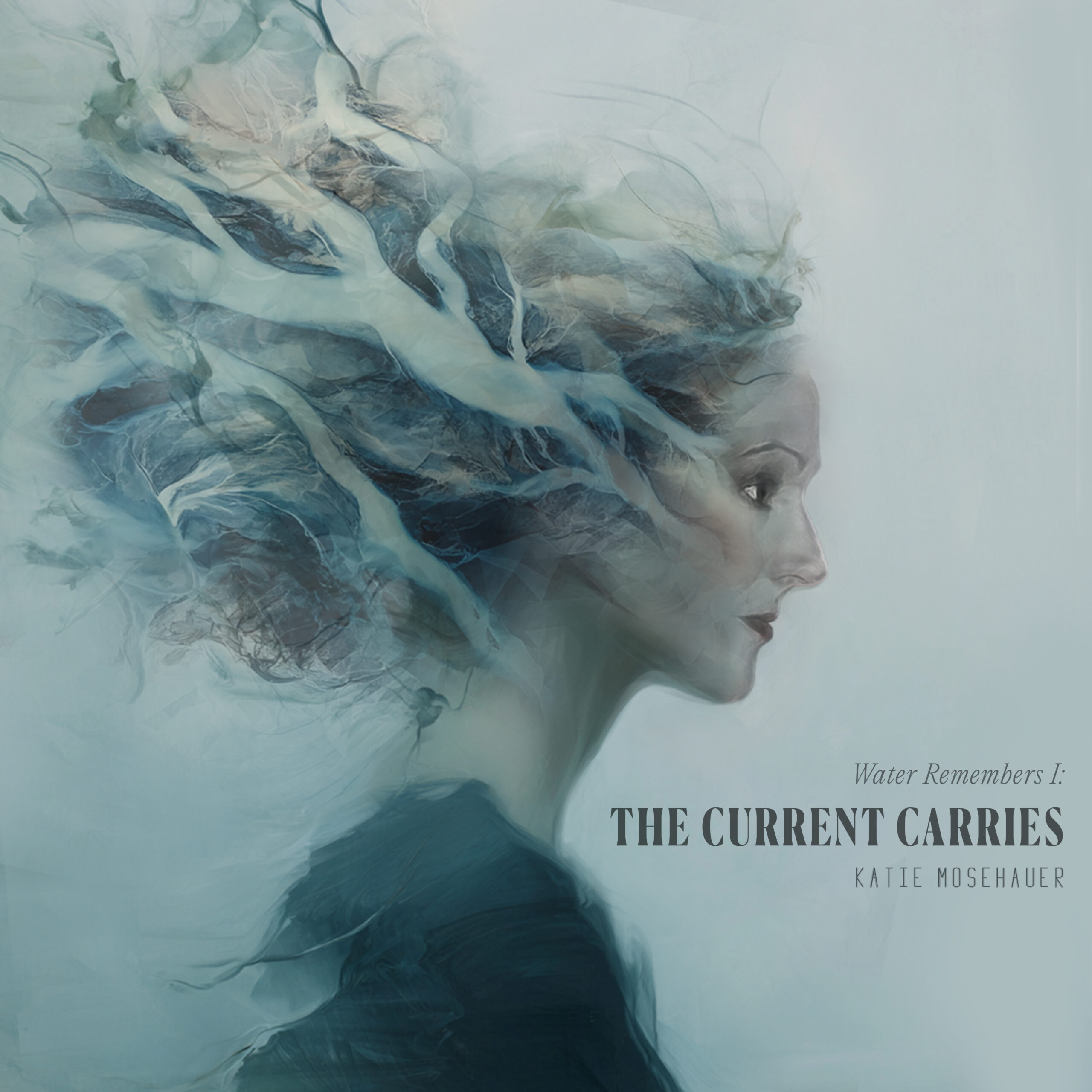
Katie Mosehauer’s “Converging Tides (after Liszt)” is a considered reworking of a piece of classical music, an exploration of what might happen if you take a piece of music that you know and love and allow it to change, without necessarily losing the emotional resonance that made it so powerful in the first place. It forms part of the *Water Remembers I: The Current Carries* release and is based on Liszt’s “Consolations, S. 172: No. 3 in D-flat Major”. Rather than just reworking the piece in a conventional sense, Mosehauer uses it as a springboard for a new musical journey, combining strings, synths and sound design in a very intimate and immersive way. It’s a piece that brings together the classical with the contemporary, where the sense of nostalgia is very much present but there’s also a sense of curiosity and a desire to go beyond the original. The title “Converging Tides” speaks to the idea of different forces meeting, influencing each other and creating a movement that isn’t necessarily in one direction. That is the central idea of the piece; music can have the emotional imprint of its origins and yet be transformed through reinterpretation. Mosehauer describes her approach as being able to stay in touch with what it was that moved her in the original piece, and at the same time be able to allow new sounds, new textures and new ideas to emerge. “The past is not a finished composition; it is a living melody which is continually being reshaped by the people who carry it forward.” That is the essence of the piece and the feeling it seeks to convey. It is a piece that is both nostalgic and searching, one that holds on to the beauty of the original while also making space for something else to emerge. It is a piece that asks you to listen to it with patience, to allow the memory of the past and the potential of the future to co-exist. Mosehauer is a classically trained violinist, composer and producer and her work spans violin, viola, cello, harp, piano, synths and sound design. That breadth of experience underpins the approach taken in this piece, an approach which is fundamentally about transformation. The piece is described as being nostalgic and searching, a piece that retains the beauty of what has already been and is at the same time open to what may come next. It is an invitation to listen.

Water Remembers is a four part audio visual project. The concept is to take a canonical classical work and then create an original piece from its musical material, thus creating a dialogue between the tradition and the present. Volume one, Water Remembers I: The Current Carries, features two pieces: Liszt’s “Consolations” S.172 No.3 in D flat major Lento placido for violin and harp and Mosehauer’s own response “Converging Tides (after Liszt)”. The piece is about collective action, impermanence and the question of what we carry with us. The film that accompanies it takes these ideas further with movement, repetition, interruption and renewed gesture. Mosehauer has been working in the field of criminal justice and social justice reform for over ten years and that experience is at the heart of her understanding of how fragile progress can be. Progress may seem inevitable from a distance but on closer inspection it’s clear how much depends on people continuing to do the work, even when the outcome is uncertain. That’s the essence of The Current Carries where the movement of the music and the film is the work itself. The film features repeated gestures that falter and then restart again. That’s the visual equivalent of the idea that no one movement will transform the landscape, but each movement does contribute to what comes next. The project is therefore much more than a classical reimagining. It’s about the inheritance of systems, the shaping of the present by collective memory and the power of the stories we tell ourselves about what is possible. Mosehauer’s artistic practice is the bridge between her musical training and her experience in the social justice field rather than the two being separate. The next three volumes of Water Remembers will be about faltering expectations, the loss of the familiar and the relationship between beauty and violence in the contemporary world. The series as a whole is about how we remember things and how that memory and what we value changes over time. The Current Carries is the starting point of the series and it shows how a canonical work can be the beginning of a new reflection, a new way of thinking about what we have inherited.
Mosehauer’s wider body of work reinforces her unique position as a performer, independent musician and storyteller. She has performed with the Charlottesville Symphony, the Puget Sound Symphony Orchestra and the Seattle Rock Orchestra and has also recorded and toured with a number of independent and cross genre projects including her own band Glass Heart String Choir. Her original music has been shortlisted for the International Songwriting Competition, the International Acoustic Music Awards and the One World Music Awards and she is a voting member of the Recording Academy. She is also a director and producer of films which use movement, landscape, texture and cinematic imagery to extend the emotional and conceptual dimensions of her work. Based in the Coachella Valley in California she sees music as the core of a wider creative practice, one that links sound to image, to the body and to the environments in which we live. “Converging Tides (after Liszt)” is a case in point where the accompanying film is not simply a visual accompaniment to the music but in fact another way of engaging with the piece’s central questions of memory, time and transformation. The interplay of music and moving image invites the audience to consider how the perspective we take on a piece can change the way we understand it and how the act of re-engaging with something we know well can lead to the discovery of new details. There is a real emotional openness in the piece too. While the work is concerned with collective action and the precariousness of progress it doesn’t restrict itself to a single reading. You can approach it through the emotional power of the Liszt melody, through the evolving textures of Mosehauer’s own composition or through the questions it raises in the context of the audiovisual work. That openness is part of its strength in that it creates space for reflection rather than demanding a particular response. “Water Remembers I: The Current Carries” was released on all streaming platforms on 23rd October 2026 as the first of a project which seeks to link classical heritage with contemporary artistic and social questions. “Converging Tides (after Liszt)” is compelling in the way it treats musical history as something that is in perpetual motion. It recognises the power of the familiar and allows that familiarity to be reconfigured through new instrumentation, production and perspective. Mosehauer’s work asks us to slow down, to look again and to stay with the complexity long enough for a new understanding to emerge. In that it is a reminder that transformation doesn’t always require the abandonment of what came before. Sometimes the most meaningful way forward is to carry the past into a new current and see where that takes you.
Facebook, Soundcloud, Youtube, Instagram, Spotify, website