“A better world begins when we dare to question the one we know.”
Some songs are content to tell a story, while others challenge listeners to reconsider the stories they have always believed. Aaron Koenig’s “Let’s Imagine” belongs firmly in the latter category, transforming an ambitious vision of freedom, cooperation, and social change into an uplifting musical experience. Drawing inspiration from the idealistic message of John Lennon’s legendary “Imagine,” Koenig approaches familiar questions about humanity and the future from his own distinctive perspective. Rather than simply dreaming of a world without conflict, he encourages listeners to consider how society might function if people were given greater freedom to organise their lives through voluntary cooperation. It is a bold concept, but what makes the track compelling is the way its message is woven into the music. The song does not arrive as a political lecture or a list of demands. Instead, it opens a conversation, inviting listeners to explore possibilities beyond the structures and assumptions they have grown accustomed to accepting. Musically, “Let’s Imagine” begins with a warm acoustic guitar that establishes an intimate, reflective atmosphere. There is something immediately inviting about this opening, as though Koenig is sitting across from the listener and sharing an idea that deserves a moment of genuine consideration. The guitar provides a simple, organic foundation, allowing the song’s central message to emerge without unnecessary distraction. As the arrangement develops, piano, bass, expressive drums, and sweeping strings gradually expand the sound, adding depth and emotional intensity. The piano introduces a tender quality, while the strings give the composition a cinematic dimension that becomes increasingly powerful as the song progresses. Each instrument contributes to the sense of movement, carrying the track from quiet contemplation toward something considerably bigger. The gradual build is particularly effective because it mirrors the song’s central idea: a small thought can grow into a much larger vision when people are willing to embrace it. Rather than relying on an overwhelming production from the beginning, Koenig allows the arrangement to breathe, creating space for the music and message to develop together.
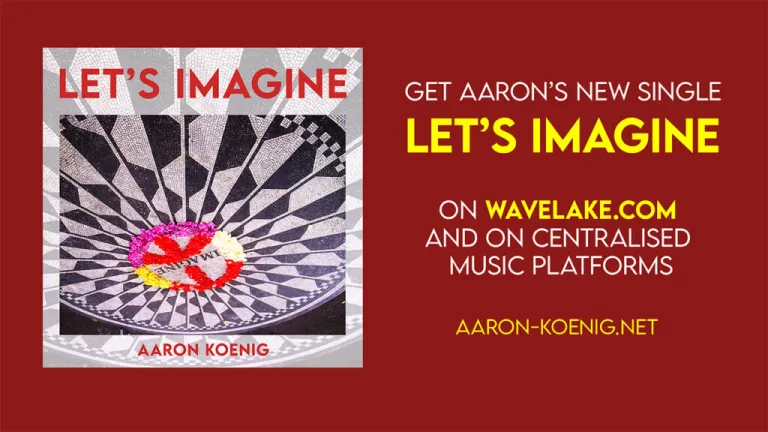
“Let’s Imagine” takes on questions that are both philosophical and deeply relevant to the way people think about their lives. Koenig invites listeners to picture a society without governments, exploring the possibility of individuals coordinating their affairs through voluntary cooperation instead of centralised authority. He also considers how decentralised technology might create new opportunities for personal freedom, giving the song a contemporary dimension that distinguishes it from the idealistic songwriting that inspired it. These are substantial ideas, and they naturally invite disagreement, discussion, and scrutiny. However, the strength of the song lies in its willingness to ask questions rather than pretend that complicated social challenges have simple answers. Koenig’s approach gives the track room to reach beyond listeners who already share his beliefs. Those who agree with his perspective may find an inspiring expression of principles they hold dear, while those who remain unconvinced can still engage with the broader invitation to question established systems and consider alternative possibilities. The influence of Lennon’s “Imagine” can be felt in the underlying ambition to look beyond the world as it currently exists, but Koenig takes the conversation in a different direction. Where the classic song is widely associated with peace and the removal of divisions between people, “Let’s Imagine” places particular emphasis on individual choice, voluntary association, and the potential of technological innovation to reshape society. That distinction gives the track an identity of its own, allowing it to draw upon a familiar tradition without simply repeating its predecessor’s message. Equally important is the way the musical arrangement supports these ideas. The melody remains accessible, giving the lyrics a natural flow, while the expanding instrumentation adds emotional weight without overwhelming the song’s reflective character. There is a clear sense of optimism throughout, but it is an optimism built around possibility rather than certainty. “The most powerful revolutions sometimes begin with a simple question: what if we could build something better?” That sentiment captures the spirit of Koenig’s songwriting, balancing an idealistic outlook with an invitation to think independently. The song asks listeners to imagine a different future, but it leaves them to decide what that future should look like.
As “Let’s Imagine” moves toward its bigger moments, the track begins to reveal its potential as a genuine singalong anthem. The acoustic guitar remains an important anchor, preserving the warmth and intimacy of the opening, while the fuller instrumentation gives the chorus a sense of scale and collective energy. This contrast between personal reflection and expansive musical expression is one of the song’s most appealing qualities. It feels designed not only for solitary listening but also for moments when people can come together and share in the emotion of the music. Reports of audiences raising their phone lights during live performances reinforce that impression, suggesting that the song’s message can become a shared experience rather than remaining an abstract collection of ideas. There is something fitting about that response: a track centred on freedom and cooperation finding its strongest expression when a room full of individuals creates a moment together. The arrangement helps make that connection possible, gradually building an atmosphere that feels increasingly communal without losing the sincerity of its acoustic foundation. Koenig understands the importance of accessibility when addressing ambitious themes, and “Let’s Imagine” benefits from a melody that listeners can connect with even if they approach its ideas from different perspectives. The track does not need to resolve every political or philosophical question it raises to make its presence felt. Its purpose is to encourage curiosity, challenge assumptions, and remind listeners that the future is not necessarily limited to the possibilities they have already been shown. By combining thoughtful lyrics with warm instrumentation, a steadily rising arrangement, and an unmistakably hopeful spirit, Koenig delivers a song that reaches beyond conventional entertainment. “Let’s Imagine” carries the tradition of idealistic, message-driven songwriting into a modern conversation about personal freedom, social organisation, and the possibilities created by human imagination. Its greatest strength is the connection between its intimate musical opening and its increasingly expansive sound, a progression that gives the central message room to grow and resonate. Whether listeners embrace Koenig’s vision or simply appreciate the questions it raises, the song offers a worthwhile invitation to look at familiar realities from a different angle. “You cannot create a different future by imagining the same old world.” With “Let’s Imagine,” Aaron Koenig makes a case for keeping that imagination alive, delivering an uplifting, thought-provoking track that encourages listeners to question the familiar, consider the possible, and recognise that every meaningful vision of change begins with the courage to think differently.