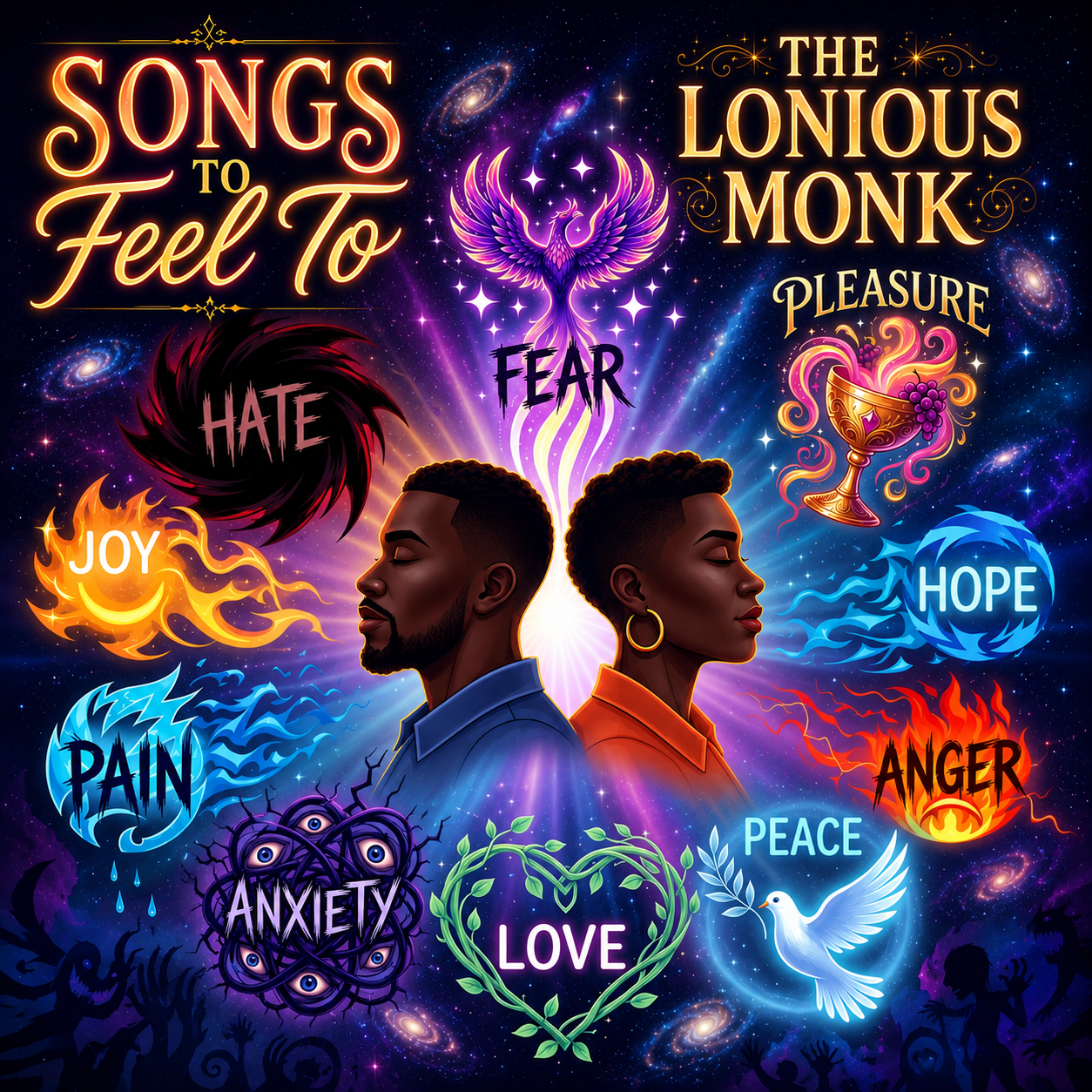
“What if every emotion had its own soundtrack? The Lonious Monk doesn’t just ask the question—he builds an entire album around it.”
The Lonious Monk’s debut Songs to Feel To is an ambitious attempt to turn the emotional spectrum into a musical journey, and its sequencing is what makes the concept immediately interesting. Rather than presenting a collection of unrelated songs, the album is structured almost like an emotional map, beginning with “The Bad (Intro)” before moving through Anger, Hate, Fear, Pain, and Anxiety. Each title establishes a different emotional destination, while the changing musical approaches allow the record to continually reset its atmosphere. “Anger” brings a heavier, metal-inspired intensity, while the darker themes that follow create a progressively more uneasy stretch before “The Good (Interlude)” acts as a turning point. From there, the record begins climbing toward Joy, Love, Hope, Pleasure, and Peace, creating a noticeable shift from emotional heaviness toward warmth and release. It gives Songs to Feel To a sense of movement that makes the tracklist feel carefully considered rather than simply assembled.

The strongest element of the album is its willingness to let different emotions dictate different musical identities. There is no attempt to force every song into the same sonic box, because the entire premise depends on contrast. Anger needs intensity; fear needs tension; pain and anxiety occupy more unsettled territory, while Joy and Love can open the record into brighter spaces. “Hope” becomes particularly important within that progression because it represents the possibility of change, while “Pleasure” and “Peace” push the emotional journey toward its most comforting territory. The interludes and bookending tracks also give the album a theatrical quality, making it feel closer to a beginning-to-end experience than a playlist of individual moods. By the time “Feelings (Outro)” arrives, the listener has effectively travelled through two opposing halves of the human experience, from darkness into light, without pretending that either side exists independently.
What makes Songs to Feel To compelling as a debut is the scale of the idea behind it. The Lonious Monk approaches music less as a single genre exercise and more as a storytelling medium, using different sounds to explore the many contradictions that come with being human. The album can be intense, uncomfortable, uplifting, tender, and reflective within the same listening session, and that unpredictability becomes part of its identity. There is something almost cinematic about the complete journey: The Bad opens the door, the individual emotions take over, The Good provides the turning point, and Feelings brings everything back together. Songs to Feel To ultimately succeeds as an invitation to experience music emotionally rather than simply categorize it—a debut built around the idea that sometimes the most powerful songs are the ones that make us recognize something already living inside us.